Mistral Opens the Weights of Its 1 Trillion Parameter Model
Mistral AI has released the weights of Mistral Large 4, a 1 trillion parameter multimodal model, so anyone can download it, run it on their own servers and fine-tune it. The weights are free under a modified MIT license, with one catch: companies that sell the model as a hosted service need a separate license from Mistral. Anyone who would rather not run it can use Mistral's API, which charges $0.70 per million input tokens and $2.10 per million output tokens. The French company, which nicknames the model "Le Chonk," says it is the best open-weight model for coding.
Large 4 first launched in public preview earlier this month. Mistral says it spent three more weeks on reinforcement learning since then, and that the gains in coding and defensive security have not leveled off.
Mistral also stresses that it trained the model from scratch on European infrastructure. That means the training ran on servers in Europe, and that Mistral built the model itself instead of starting from another company's. The announcement does not name the data centers or the hardware. This matters to Mistral’s customers because of its “sovereign AI” pitch: a customer should own and control the AI it depends on. For a European bank or agency, that means knowing where its data and computing sit, which country’s laws apply, and that nothing in the model’s history depends on a US or Chinese provider. Mistral says open weights and European training are how it delivers that.
Mistral's strongest claim is in coding: On Cognition's private FrontierCode 2.0 test, which asks whether a repository maintainer would merge the agent's change, Large 4 scored 19.7%. That is the top mark among the open models Mistral charted.
On the Artificial Analysis Coding Agent Index it scored 48%, about even with the leader GLM-5.3, while using 47% fewer tokens per task. Fewer tokens means a cheaper agent at scale.
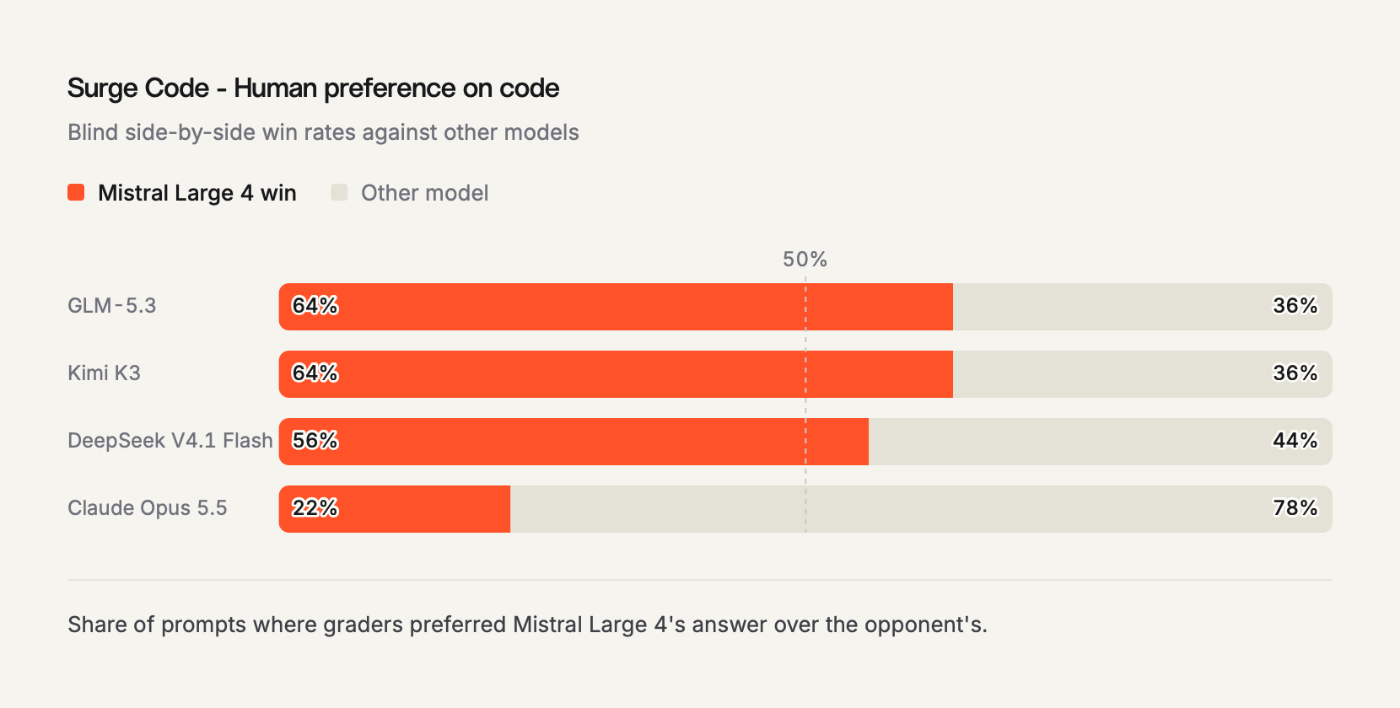
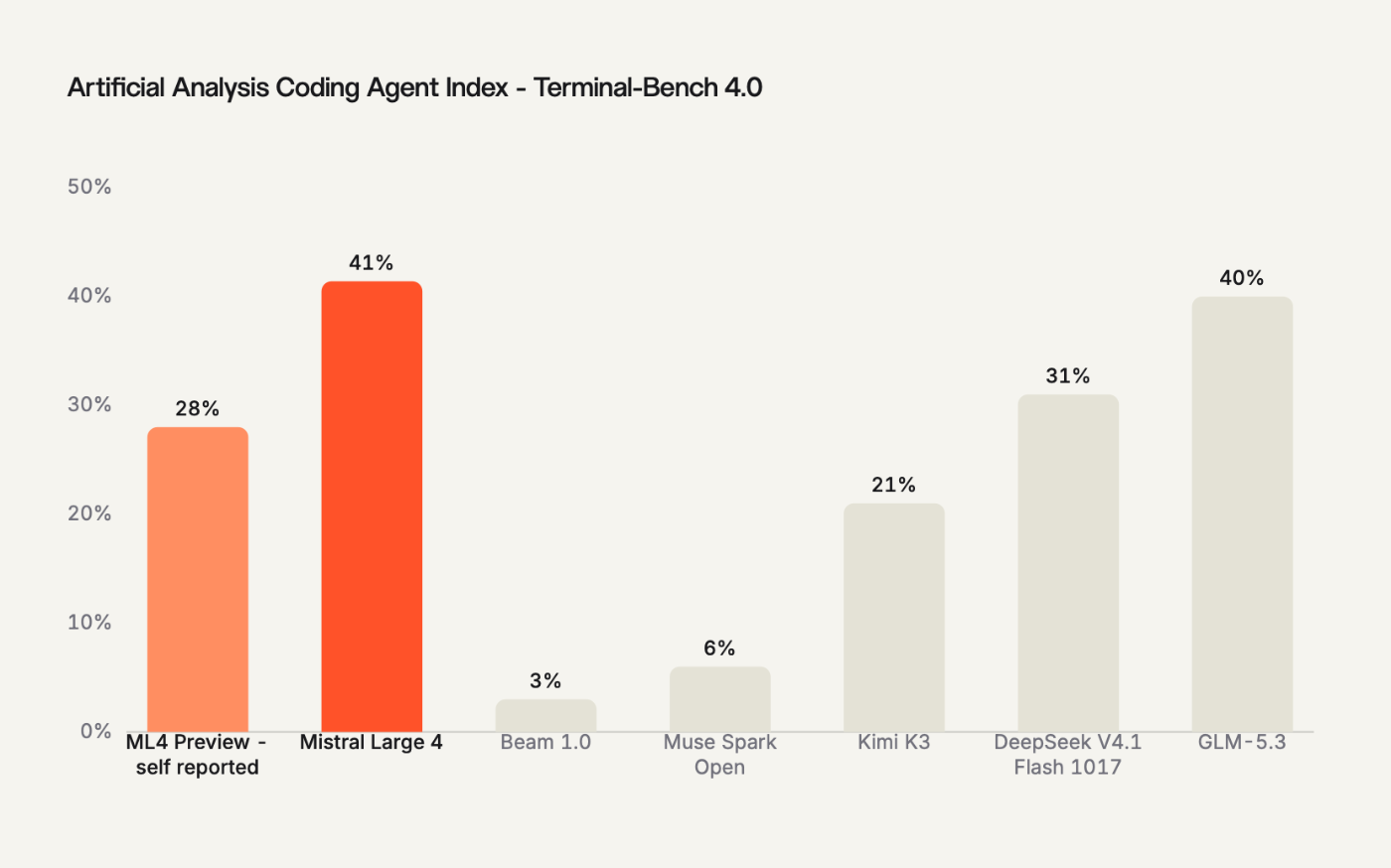
On Terminal-Bench 4.0 it reached 41%, up 13 points from the preview, with 30% fewer output tokens. In blind side-by-side tests run by Surge Code, graders preferred Large 4 over GLM-5.3, Kimi K3 and DeepSeek V4.1 Flash. Only Claude Opus 5.5 ranked above it, beating it in 78% of the prompts compared.
Mistral also leans hard on security with its new model: Large 4 scored 51% on the Artificial Analysis Cyber Index, which tests whether a model can find a vulnerability, reproduce it and patch it without breaking the code. Mistral says it does this work without needless refusals. Its own chart shows several rivals scoring higher, including DeepSeek V4.1 Flash at 57%.
The company says the model refuses 96.6% of malicious cyber requests, the highest rate it measured among open models. But Mistral also admits something most vendors skip. Watching live traffic since the preview, it saw the model refuse black-box attacks on live targets, yet it sees potential for real attack uplift. It is tightening the guardrails and will keep updating them.
That matters more with open weights. When Mistral runs the model on its own servers, it can watch how people use it, stop abuse and change the safety rules at any time. When a model is downloaded Mistral can't see what happens to it, and a determined user could retrain it to remove the safeguards.
Mistral treats this risk with a stronger version built for penetration testing and red-teaming, which means simulated attacks that find holes in a company's defenses. It goes only to vetted partners such as Orange Cyberdefense, under contract, and only for systems they own or are authorized to test.
Two questions matter most from here: The first is whether outside evaluations confirm the coding and token-efficiency claims. Now that the weights are public, independent teams can run their own tests and check them. The second is how the guardrails hold up once the weights are in the wild. Mistral says the model refuses 96.6% of malicious cyber requests, but it also noted a potential for real attack uplift and is changing its guardrails.
© Raydn · raydn.us