How the World Divides: What the Data Says
Discussions of world politics usually begin with an idea, such as a new cold war, a rising China or a Global South, and then look for fitting evidence. This analysis does the opposite: it collects the measurable ties between countries and lets a standard statistical method say how the world divides.
Published
The data covers 82 countries, 35 alliances, and 84 relationships between pairs of them like wars, severed embassies, arms supplies, bases, peace accords, export controls, the chip chokepoints one country holds over another, or the countries shut out of dollar clearing. To that it adds $31.5 trillion of commerce, goods, energy, chips and services, moving between 3,306 pairs of countries.
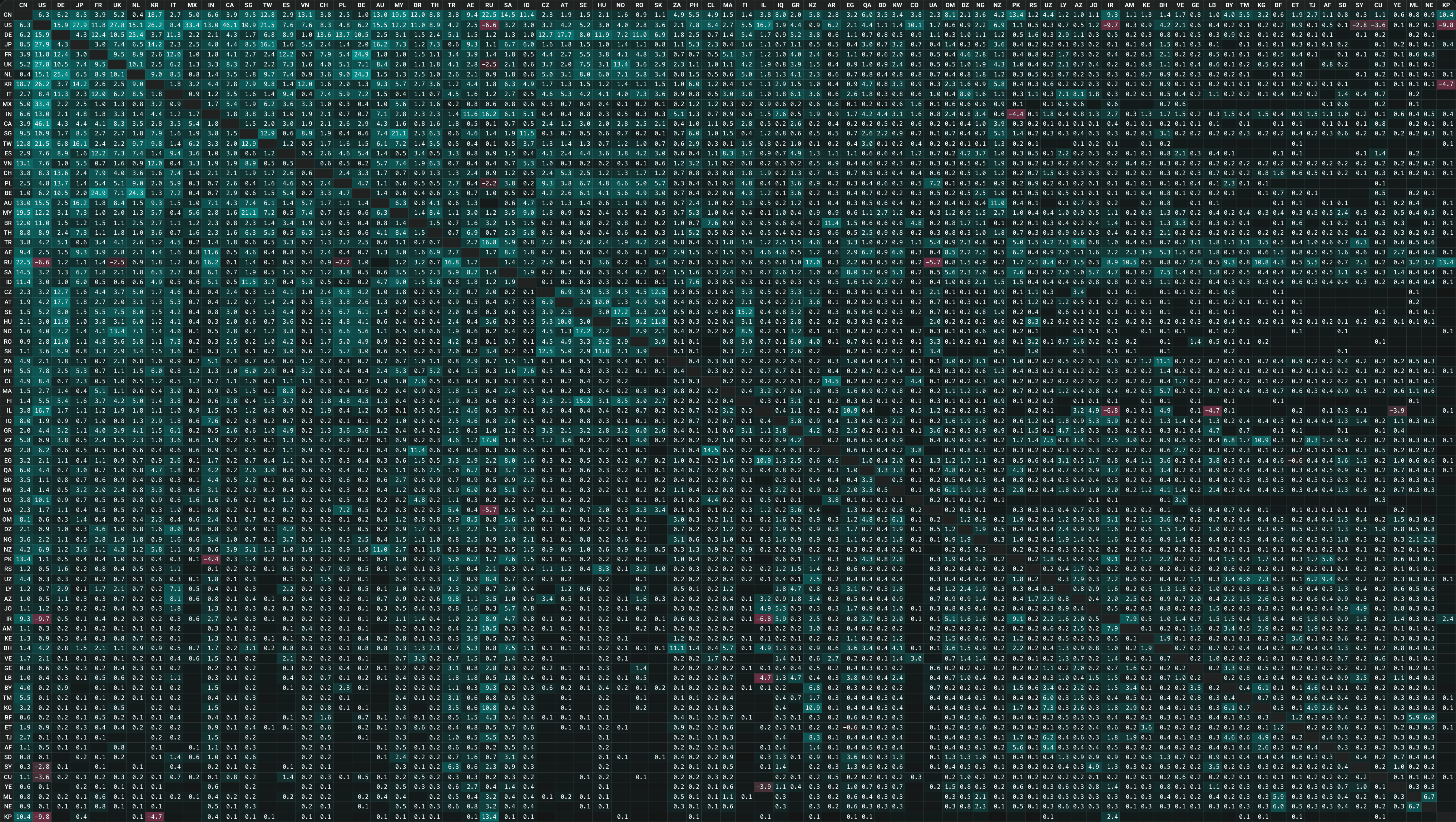
All data points are further compressed to one single score, fed into a grid, which captures all measured relationships between each of the 82 countries, and then run through the same eigenportfolio analysis a money manager uses to find the hidden forces that move large sets of stocks. The model returns a number of portfolios or themes that uncover the factors which are explaining this grid the best without being told in advance where a country belongs. Four big themes hold up, and are together able to explain 44% of the grid. The remaining 56% is made up of weaker, unstable themes, and idiosyncratic relationships: ties particular to one pair of countries.
The four forces that shape our world
1) The West against the Russian bloc (explanatory power 18%): The Cold War line, redrawn by the war in Ukraine. NATO, the European Union, the sanctions coalition and Five Eyes bind one end; the Belt and Road Initiative, the Shanghai Cooperation Organisation, Russia's defence pact and the Organisation of Islamic Cooperation bind the other. This theme is shaped mainly by alliances (47%), energy & trade including services (39%), other ties (7%) and chips (6%).
2) The sea against the land (13%): America and its trading partners around the Pacific and in Latin America against the countries of the Eurasian interior, Europe included. The Pacific trade pacts, RCEP, the CPTPP and ASEAN, together with the Rio Treaty, a defence pact, hold one end together, and European and Eurasian membership holds the other. What divides them is geography written as trade: sea routes and port-to-port dependence on one side, overland pipelines and neighbours on the other. Trade (32%) and energy (29%) are the main glue, followed by alliances (25%), and chips (12%).
3) Russia's circle against the Arab world and Africa (7%): Two non-Western camps that are usually treated as one, pulled apart. Russia's defence pact, the Eurasian Economic Union and the Commonwealth of Independent States bind one end; the Arab League, the Gulf Cooperation Council, the African Union and the Sahel juntas bind the other. The two systems overlap almost nowhere, and oil sold to different customers keeps them apart. Alliances (47%) is the big factor here, followed by trade (24%), energy (21%), and chips (8%).
4) Southeast Asia against South America (6%): Two trading blocs on opposite sides of the world with almost nothing running between them. Singapore, Indonesia, Malaysia and Japan form the Asian end, joined by the UAE and Saudi Arabia; Mercosur and the Rio Treaty hold the South American one. This theme is defined by energy (36%), alliances (35%), and trade (27%). It rests heavily on the Rio Treaty, a largely dormant 1947 defence pact: take the treaty out and this theme disappears.
The surface: the world as it stands
When the two main themes which account for 31% of the grid are drawn against each other, the countries divide into four larger groups: The United States, Japan, South Korea, and other Pacific countries fall into the top left. China, India and the Gulf States fall into the top right, and Russia, Iran, North Korea and Central Asia occupy the bottom right. The bottom left is populated by Europe. The four corners are anchored by the US in the top left, due to its shared interests with both Europe and the Pacific, China in the top right, much better integrated into the global system than Russia, Russia in the bottom right, and Germany in the bottom left as the most embedded power of the West.
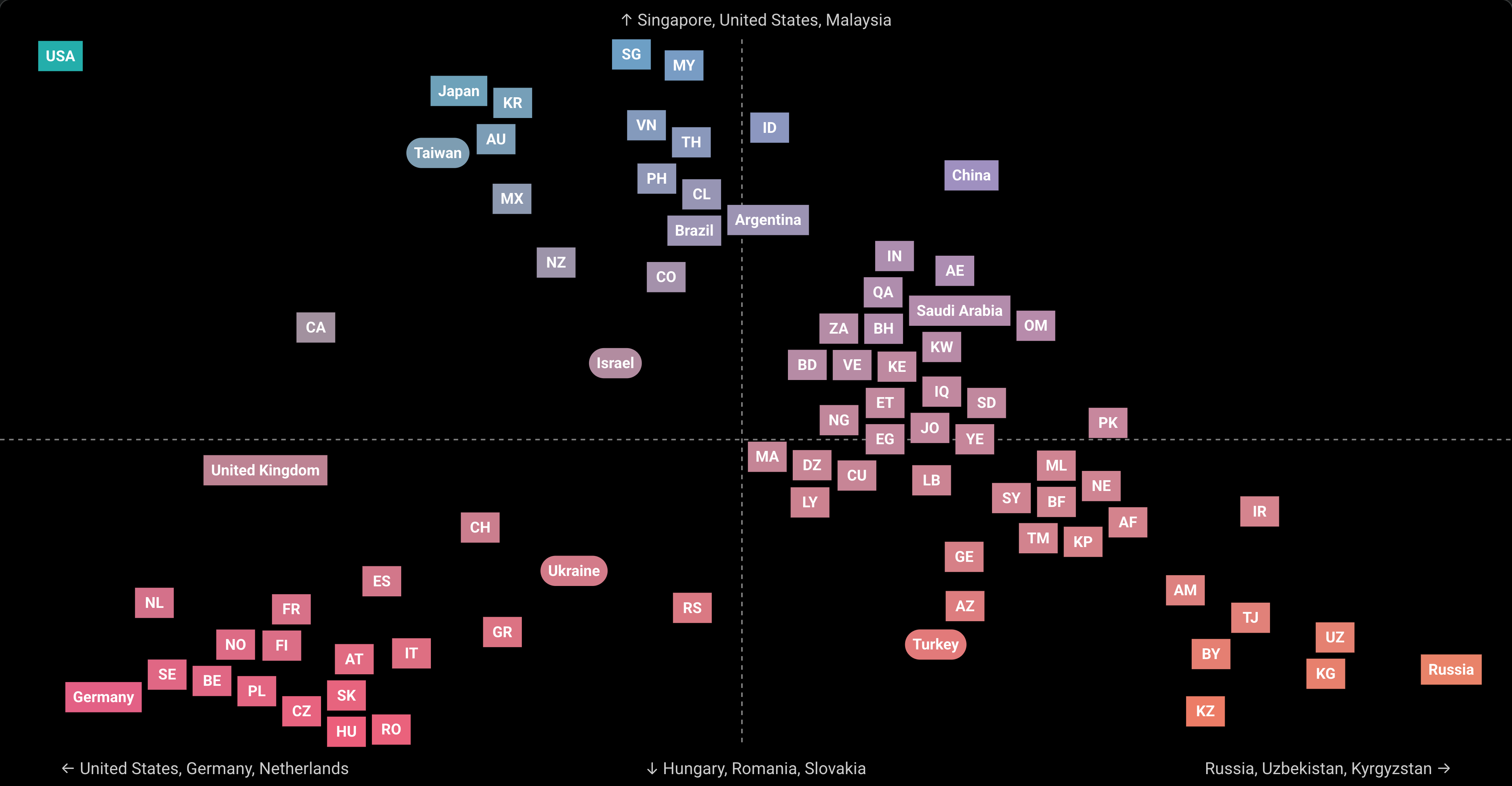
Three placements are rather interesting: Israel is mapped into the central void because it belongs to none of the major alliances, and appears to be a bridge rather than an outpost of the West. Turkey - despite being a formal NATO member - is closer aligned with the Russia/Central Asia bucket. Ukraine is pulled towards the US/Europe due to the war, but would otherwise be a very central country because like Israel it is not part of any major alliance.
The undercurrent: a split inside the non-Western world
The chart above shows the world largely as the Cold War left it, but drawing the first theme against the third reveals a hidden pattern, which explain about 25% of the grid.
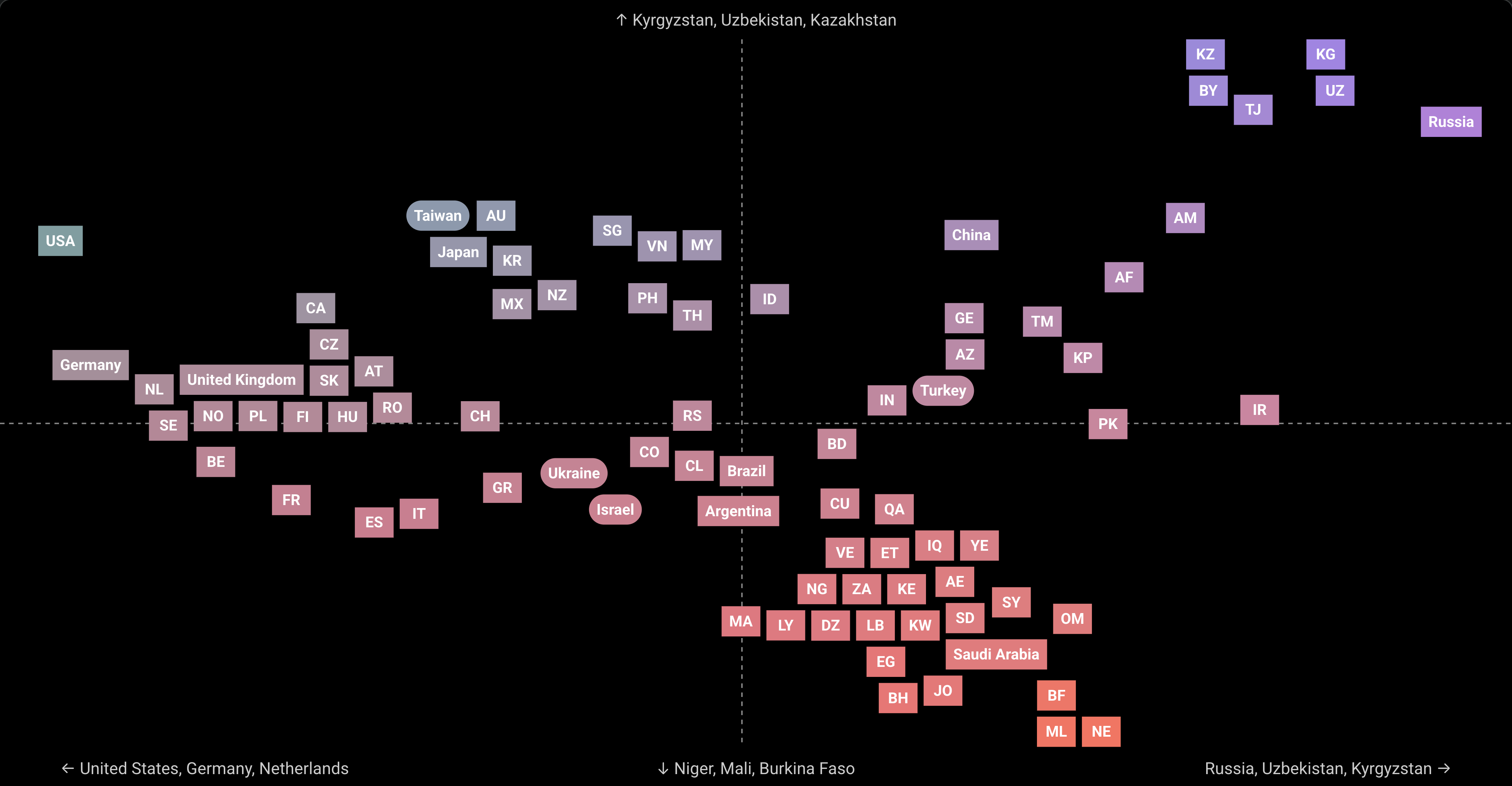
On the x-axis again the West-East divide, but on the y-axis we now map the third theme, which divides the non-Western world in two: At one end the Russian influence sphere, held together by Russia's defence pact, the Eurasian Economic Union and the Commonwealth of Independent States, plus to a lesser degree China. At the other end Saudi Arabia, the Arab League, the Gulf Cooperation Council and the African Union. Israel, Argentina, and Brazil sit at the centre but are clearly tilted towards the southern cluster. Turkey is placed between all chairs, which is a fair description of a country that borders Russia's sphere and the Middle East at once.
The bedrock: if the Cold War line fades
The next chart is a thought experiment. It describes a divide that does not dominate today, but it shows what the world would look like if the first theme (The West against the Russian bloc) lost its hold. The themes are measured independently of each other, so a weaker first theme would not by itself make the second or third take over; the chart only shows what already sits underneath. Given recent developments such as the overextension of the US, which may bring very real and near-term fiscal constraints, rapid demographic and political changes, this is a possible path, not a forecast.
If America's commitment to defend Europe came into doubt, if a settlement in Ukraine brought sanctions to an end, and if European governments came to see Russia as a neighbour to deal with rather than an enemy to contain, the alliances holding the first theme together would weaken, and the second and third themes would be left to describe how the world divides. This is not hypothetical only, as these forces are already in place and able to describe about 20% of the grid.
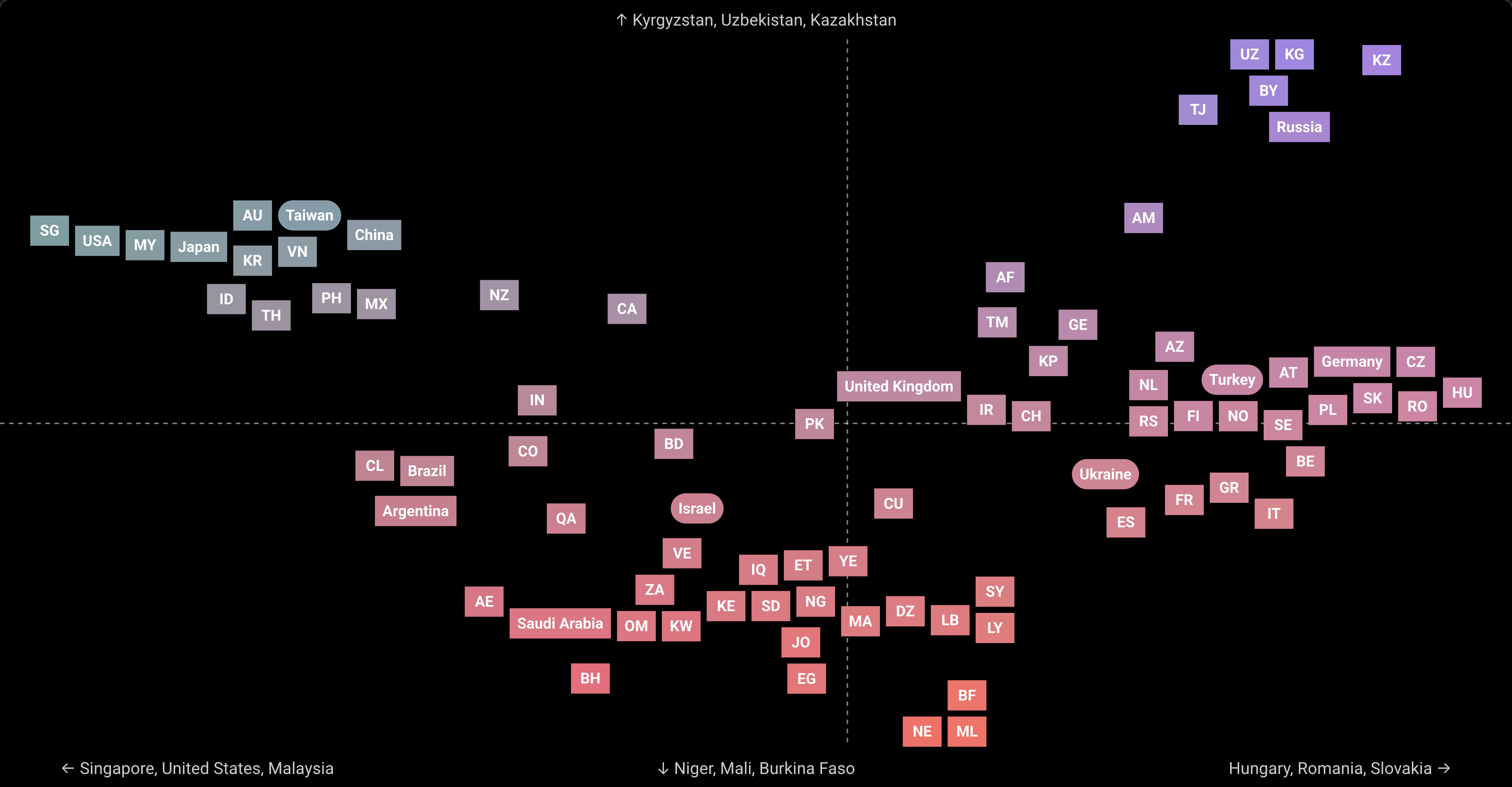
In this scenario the world is moving into a direction shaped by geography, trade and energy rather than defence: The United States puts its trade and security effort into the Pacific, the Gulf states and Africa focus on building more of their own security arrangements, like the Saudi-led Mecca Defence Alliance, while Russia draws back to the post-Soviet states that already form its inner circle. A striking feature is the proximity of China to the Pacific bloc, and the drift of Brazil and Argentina towards the Gulf.
The result would be a world of four parts: a maritime America allied with Asia, a continental Europe that trades eastward alongside Russia and Turkey, a south grouping around the Arab world and Israel, and Russia in the north. The plumbing for it is already in place.
We hope you enjoyed this unconventional, data-driven approach to geopolitics, and that it sparked your curiosity.